Showing posts with label sport. Show all posts

Sunday, January 1, 2017

Introducing The Hybrid Swing Plane

Today I have another great article by Jeff Richmond that explains the Hybrid Golf Swing Plane he advocates and teaches. Let's get started...


The Hybrid Golf Swing Plane

By Jeff Richmond

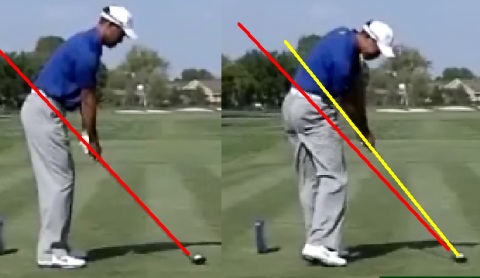
A big tenant of the one plane golf swing is to return the golf club back to the same position it was (in terms of the shaft plane line) at address. That's what Moe Norman and Ben Hogan did.

Click Here


But let's see how some of the top golfers in the last 10 years fare as far as that is concerned.

1. Tiger Woods


2. Adam Scott
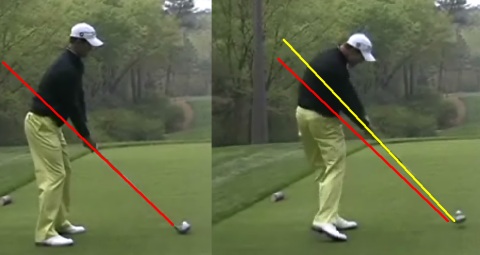


3. Phil Mickelson
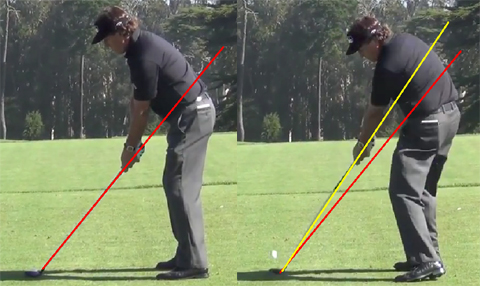


4. Rory McIlroy
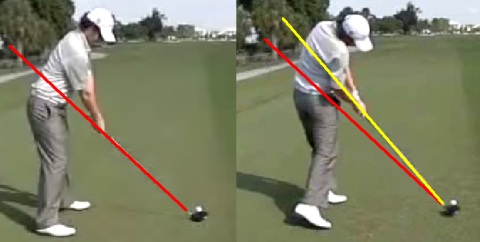


5. Justin Rose
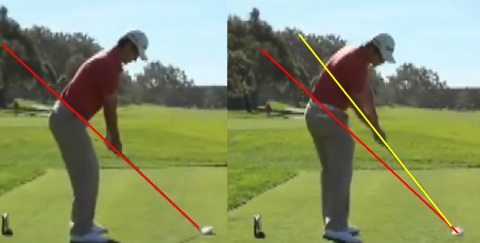


6. Henrik Stenson


7. Matt Kucher
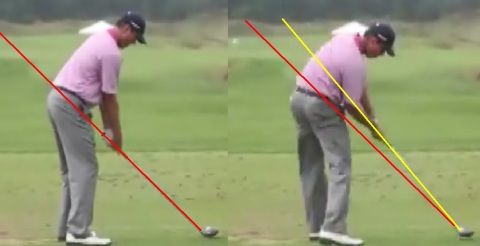


8. Brandt Snedeker
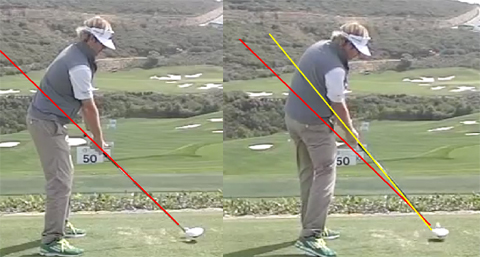


9. Steve Stricker
'

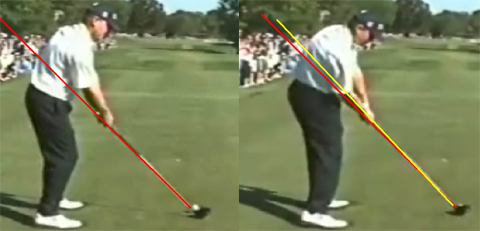
10. Jason Duffner


So 9 of the top 10 golfers in the world over the last 10 years DO NOT return the clubface to the same plane line that they started at at address (Steve Stricker does).

Click Here

Why did I show you that?

Because I believe the plane line should be more vertical than a one plane swing, and not as vertical as a two plane swing. Somewhere in the middle. A great model I'm going to show you in a minute for this, is Louis Oosthuizen.

But these impact pictures begs the question... are they trying to do that?

Click Here

The answer is no!

Because it's been proven that the golf swing is moving way too fast at impact to consciously do anything. So what is happening at impact is this...

The forces are so great at impact that the hands are being pulled up. That's just a natural occurrence of the modern, powerful golf swing.
So that got me thinking how it would be good to swing on a plane that is similar to what happens at impact. Because you can talk all you want about one plane and two plane swings (in terms of the backswing and shoulder plane, left arm angle etc.). But at the end of the day, it's what happens at impact that matters.

Click Here

So my Hybrid Golf Swing Plane theory, is to swing back so that at the half-way point in the golf swing the club shaft points down at the ball. Then at the half-way point in the downswing, the clubshaft again points at the ball. I'm now going to show you this theory in action in one of the best swings on the planet.
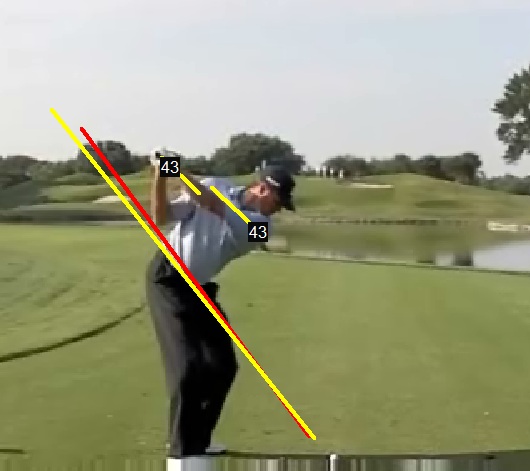
Louis Oosthuizen is the 2010 Open Champion and has a golf swing that many believe is one of the best among professional golfers. So let's put my swing plane theory to the test, and I'm going to draw a line through his setup at address right through the middle of his back.

Setup
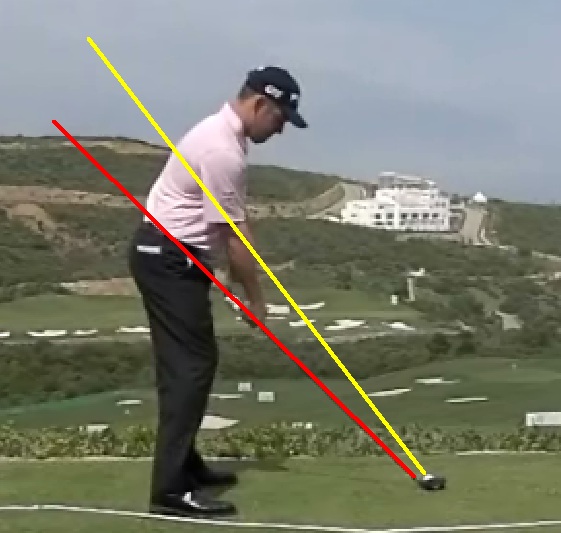


Half-Way Back
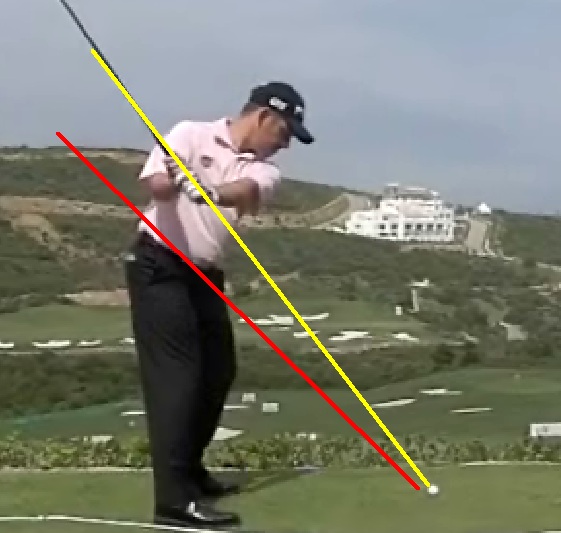


Half-Way Down
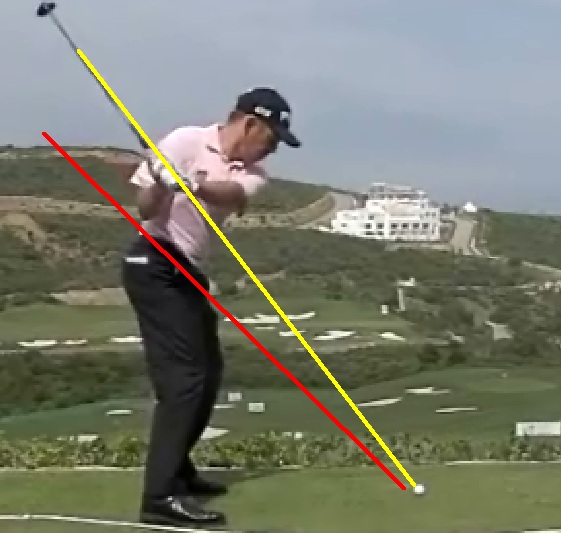


Impact
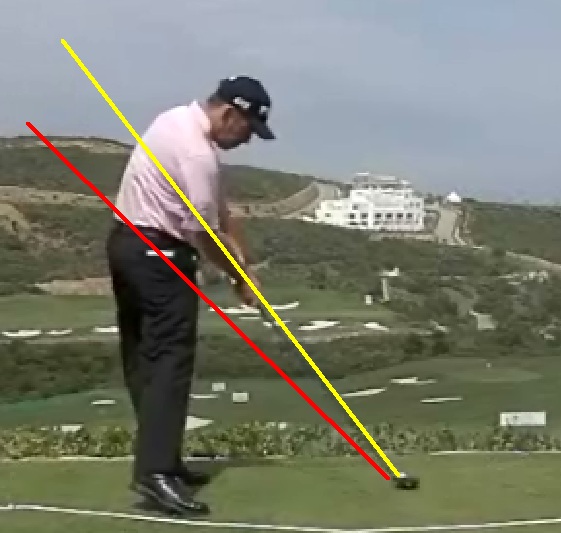


Follow-Through
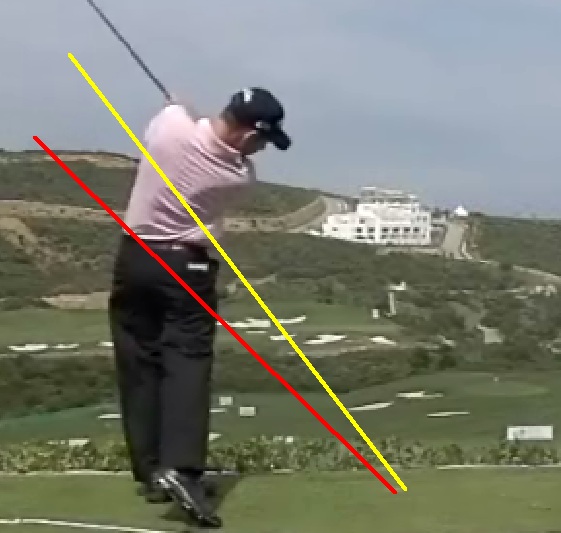


Pretty damn good swing, with a very consistent swing plane!

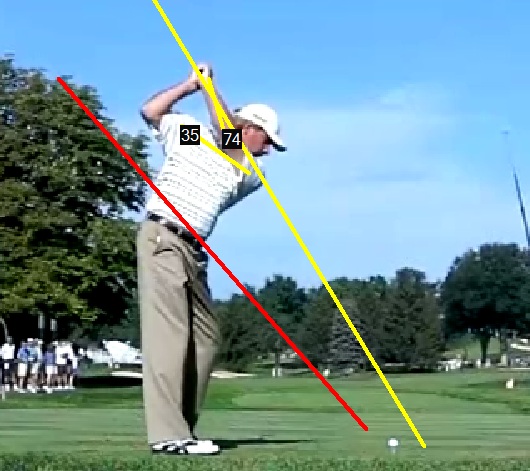
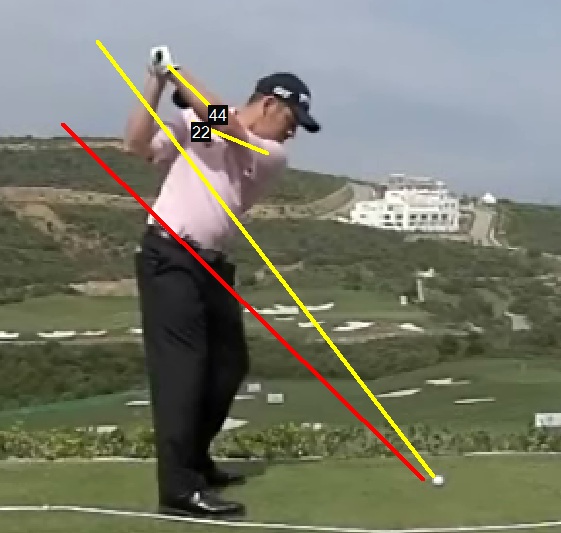
If you remember, in my last article I said a way to see if a person swings on a one plane swing, is to measure at the top of their swing the angle of the left arm and the shoulders. And if there's less than 12 degrees difference then they have a one plane swing. Let's see what the difference is for Louis:

Louis Oosthuizen - 22 Degrees Difference


Click Here

Compare that to Moe Norman and Jim Furyk. Extremes of a one plane and two plane swing:

Moe Norman (One Plane Swinger) - 0 Degrees Difference


Jim Furyk (Two Plane Swinger) - 48 Degrees Difference
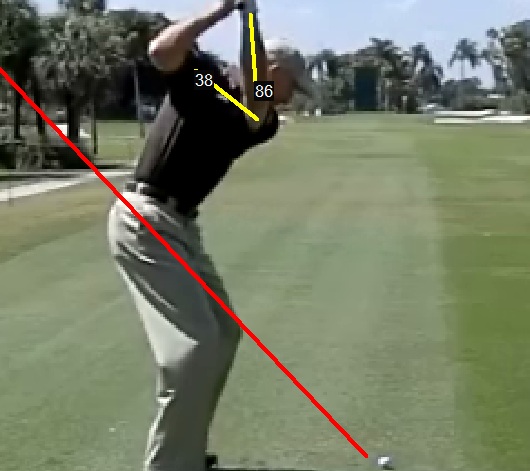


And if you split the difference between those extremes you get 24 degrees. Louis Oosthuizen at 22 Degrees Difference is almost bang in the middle.

And this swing plane that Louis uses is what I term "The Hybrid Swing Plane". I have a swing plane program in which I'm going to teach you how to groove a consistent golf swing plane like this... so watch out for an email about that program soon. 

Click Here

Having a consistent golf swing plane will help you to hit straighter, longer and more consistent golf shots. So if you lack consistency in your ball striking, working on making your golf swing plane more consistent can only aid you in improving your ball striking consistency.

Anyway, I hope this series I've given you on the swing plane has clarified a lot of issues you had with understanding the swing plane. And I hope that now you have a very clear idea on what swing plane you should be swinging back, down and through on.
 __________________________________________________

I hope you enjoyed that swing plane series by Jeff Richmond.  Jeff has a great program that helps you to build a consistent swing plane.  I'm trying to get a deal on that program for you.  Hopefully I will be in touch later this week with some good news.  

Click Here

Saturday, December 31, 2016

1 Plane Golf Swing Vs. 2 Plane Golf Swing

Hi,

Today I have another great article by Jeff Richmond that explains the differences between the one plane and two plane golf swings.

It's a very detailed and well put together article. Then coming up I have another article for you that explains the swing plane Jeff thinks most golfers should use. As you'll see, there's a middle ground.

Having said that, there's one swing plane that practically all golfers will use when they start playing golf. Read the article below to find out what that swing plane is...


One Plane / Two Plane Golf Swing Explained

By Jeff Richmond, Director of Instruction, ConsistentGolf

In this article I'm going to explain what a one plane swing is, and what a two plane swing is... in simple language... hopefully! :-)

The differences between a one plane swing and a two plane swing are quite obvious... when you know what to look for. So let's start this discussion off with a look at the one plane golf swing.

Click Here

Two of the most famous one plane swingers were Ben Hogan and Moe Norman.

Moe Norman is more extreme than Ben Hogan, so we'll look at him first.

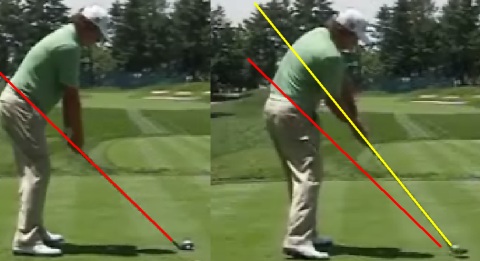
When you see Moe Norman setup it looks very odd. Here is a picture of his setup and I have drawn a line through the shaft, which is going through the middle of his back (that's important, so keep this in mind as we move through this):


As you'll notice... Moe's hands are very high and his club is set back a foot or so from the ball.

Now the key to a one plane swing, is to keep the club shaft parallel to the line that is created at setup. Then the goal is to get the club shaft back onto the same plane line that was created at setup once you reach impact. I will show you some images from a video of Moe Norman doing this.

Backswing

Downswing
Impact
Follow-Through

At crucial parts in the swing Moe's clubshaft is parallel with the shaft line that he started with at setup. Moe has a pretty unusual looking swing though. I don't know who came up with the term 'Natural Golf' but that doesn't look too natural to me!
So let's look at the more "normal" setup and swing of golf legend, Ben Hogan.

Click Here


Setup

Backswing
Downswing
Impact
Follow-Through

So that's a look at a couple of famous one plane swings. There is a measurement you can use to help determine if a golfer has a one plane or two plane swing. I'll give that to you later in this article.

But before we move onto two plane swings, I just want to make a very important point about one plane swings.

Click Here


As well as Ben Hogan and Moe Norman hit the ball with their one plane swings... they hit an awaful lot of balls (i.e. MILLIONS)! And that leads nicely into my next point, which may explain why they needed to do that...

Pretty much every golfer who starts playing the game of golf, swings with a two plane golf swing. Jack Nicklaus has a classic two plane golf swing, so let's look at his swing plane...

Setup


Backswing


Downswing

Impact

Follow-Through


Now here is an extreme opposite of Moe Norman. Jim Furyk and his two plane golf swing.

Setup


Backswing


Downswing


Impact


Follow-Through


Wow... Jim's got a lot going on with his swing plane! But he's a great golfer who proves you can play great golf with a two plane swing, just like you can with a one plane swing.

My personal opinion, based on the golfers that are great with the one plane swing, is you need to hit a lot of balls for it to work. If you don't want to be a range rat, then a two plane swing or hybrid swing plane is what you should be looking to do. In my next article I'm going to be talking about a hybrid swing plane, because I believe that's the way to go - and I'll explain why in my next article.

Before I leave you however, I just want to point out an easy way to measure whether a swing is a one plane swing or a two plane swing. Because at the half way point in the backswing and downswing, a person can have what looks like a one plane swing and yet be a two plane golf swing.

Click Here


You can measure this yourself (for your own swing) if you have a video and some golf swing video analysis software.

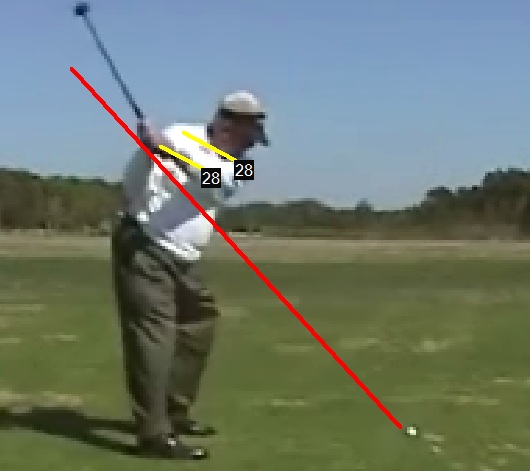
What you do is get to the top of the golfer's swing and measure the angle of the left arm and the angle of the shoulders. If the angle difference is less than 12 degrees then it's a one plane swing. If it's more than 12 degrees then it's a two plane swing. Here's some examples of one plane swings:

Ben Hogan - 2 Degrees Difference


Moe Norman - 0 Degrees Difference


Zac Johnson - 7 Degrees Difference


Matt Kucher - 1 Degree Difference


Ok, let's look at the differences between some famous two plane swingers:

Jack Nicklaus - 28 Degrees Difference


Jim Furyk - 48 Degrees Difference


David Toms - 35 Degrees Difference


Fred Couples - 39 Degrees Difference


So hopefully now you have a clear understanding of the main differences between a one plane swing and a two plane swing. As I've already said, I don't think any extreme version is right.
I would never teach a person to swing like Moe Norman. Equally, I would never teach a person to swing like Jim Furyk.

Click Here

I like the middle ground and both swing plane theories have their good points that I think can be melded into a great golf swing. So in my next article I'm going to show you a great Major winning golf swing that puts my theory into practice.

Until next time, have a great week. And now you know what to look for if you're analyzing your own swing plane, to tell whether it's a two plane or one plane golf swing.


I hope you enjoyed that second article about the swing plane. Look out for the next article, in which Jeff is going to explain the hybrid swing plane he recommends. I will send that your way soon. 

Click Here

Finally! The Golf Swing Plane Explained In Simple Language

Hi,

Today I have something new and exciting for you. Over the next few weeks I'm going to be giving you some great information about the swing plane, from a man named Jeff Richmond.

As you're no doubt aware, the swing plane is so important in terms of distance, direction and consistency. And if you get the swing plane correct, you will have way more chance of hitting good shots consistently.

So in today's first installment on the swing plane, Jeff is going to get everyone on the same page by explaining exactly what the swing plane is. And once he's done that, he will then move into some more detailed aspects of the swing plane, and what you need to do to have a consistently good swing plane.

Alrighty then, let's make a start...


What Is The Swing Plane?

By Jeff Richmond, Director of Instruction, ConsistentGolf

When you start looking at the swing plane you can get confused - FAST!

It's an area where the more scientific/engineer types seem to have a field day. And if you're not that way inclined you can read and watch some stuff on the swing plane that will just give you a headache!

In today's article, I'm going to try to keep this nice and simple so we can all be on the same page for the rest of this swing plane series.

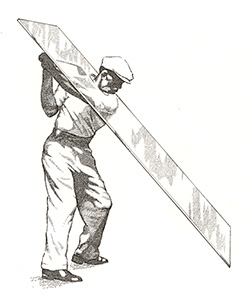
Now, the swing plane first became popular thanks to Ben Hogan and his image of a pane of glass.

When Ben Hogan was talking about the swing plane in terms of the pane of glass, he wanted the the left arm, hands, club etc. to stay below that pane of glass on the backswing and downswing.

But when Ben Hogan's famous five lessons book was published in 1957, they didn't have the technology like we do today to dissect the golf swing to the nth degree. And so the concepts of the swing plane have evolved a lot from the simple illustration that Ben Hogan gave us.

So what is the golf swing plane?

Well, the golf swing plane is an imaginary flat service that is used to determine what path certain parts of the body and club are traveling on throughout the golf swing.

This may sound stupid, but it has to be said.... the golf club cannot move itself. A lot of times when people look at the swing plane they only look at the shaft. But the shaft is only moving as a result of the body movements. So you need to look very carefully at the plane your body is moving on when looking at swing plane.

Click Here


There are three swing planes in the golf swing, and they are:
1. The backswing plane
2. The downswing plane, and
3. The follow-through plane

It's important to note that I said above "certain parts of the body and club", because when you swing your shoulders move on a plane. Your elbows move on a plane. Your hands move on a plane, your club moves on a plane etc, etc.

That's why if you see someone analyzing a golf swing, they'll draw a lot of lines to try to analyze what plane different parts of the body and club are moving on.


When you swing you're obviously swinging in a circular pattern. And because you're bent over when swinging your swing plane is tilted. How much it is tilted depends on the player's height, how they stand to the ball, the club being used etc. etc. There's a number of different variables.

Click Here


So everyone will not have the same swing plane because of this. And so there's no one exact swing plane for everyone. When I say that, I'm talking about absolute degrees of swing plane. But there are good reference points every golfer can use, and I'm going to discuss these in this swing plane educational series.

When you hear about swing plane you often hear people saying that "so and so" has a flat swing plane, or this golfer has a steep swing plane.

When people say that, what are they referring too?

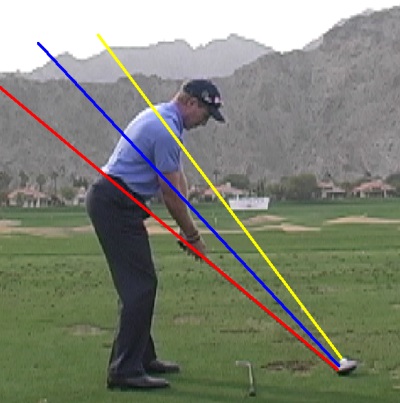
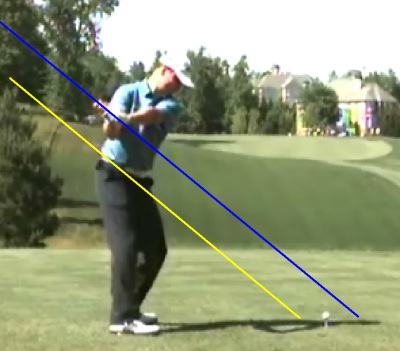
Most of the time they are referring to the shaft angle. And a good checkpoint is halfway into the backswing. A famous golf pro who is said to have a flat swing plane is Zach Johnson. Here is a picture of Zach at the half-way point in his golf swing.


Zach uses a one plane swing to hit the golf ball. So anyone that is a fan of the one plane golf swing will not say that Zach's swing is flat. They'll say it's on plane. That's where golf instructors get into arguments. In the next email I'm going to talk more about the one plane swing, two plane swing etc. But for now, notice that at the half way point in his backswing the club shaft is pointing out side the ball.

Click Here


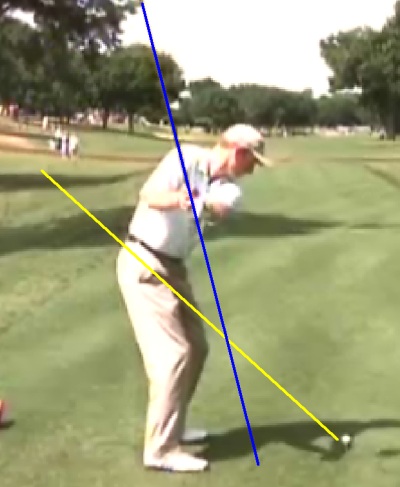
Now compare that to probably the most extreme case of a two plane swing, and that is Jim Furyk. Look where the shaft is pointing at the half way point in his backswing.


If you compare those two swing planes, is there any wonder amateur golfers are confused about the swing plane?! I imagine you're the same as me, in that you would swap your playing record with either of those two players given the choice! :-)

So the swing plane is a combination of the movement (arc) of the shoulders, arms, hands and club predominantly. And this is measured and analyzed with straight lines... so it's 2d. I have seen 3d swing plane software and analysis, but for this swing plane series I'm not even going there!

I hope that's a simple explanation and everyone is on the same page. If not, don't worry because over this swing plane series, you should hopefully get a much better understanding of it and what you should be trying to do with your swing plane.

In the next email I'm going to be looking at the different types of swing planes, e.g. the one swing plane swing, the two swing plane swing etc.

I will be giving you examples of each type of player, so hopefully you should find that interesting and informative.


I hope you enjoyed that first email about the swing plane. Look out for the next email, in which Jeff is going to explain the differences between the one plane vs. the two plane golf swing. 

I will send that your way in the next couple of days.

Click Here